
Context Engineering: The Skill That Makes AI Actually Useful in 2026
A year ago, the hot skill was prompt engineering. Everyone was writing elaborate system prompts, building prompt libraries, and sharing templates to get better responses from ChatGPT. The idea was simple: if you phrase the question better, you get a better answer.
Prompt engineering still matters. But it is no longer the limiting factor in getting useful work out of AI. The new bottleneck is context engineering, and it is fundamentally different.
What Context Engineering Actually Is
Prompt engineering is about how you ask. Context engineering is about what the AI knows before you ask.
A well-engineered prompt with no context will produce a generic, surface-level answer. The AI does not know who you are, what you are building, what decisions you have already made, or what constraints you are working within. It is written for an imaginary average user.
Context engineering changes that. It is the discipline of deciding what information the AI needs to give you a genuinely useful response, and making sure that information is actually available when the conversation starts.
This sounds simple. In practice, it is one of the hardest operational challenges in working with AI at any serious level.
Why Context Engineering Is Hard
The difficulty comes from a few directions at once.
First, context has a cost. Everything you put in the context window uses tokens. With most AI tools, you pay per token or hit a limit. Dumping everything into the context is not a strategy; it is expensive, and it dilutes the signal with noise. Good context engineering means being selective about what goes in.
Second, context decays. A project state from three months ago may be actively misleading if major decisions have changed since then. Context that is not maintained becomes a liability. The AI will confidently apply outdated assumptions if you do not curate its knowledge.
Third, context is fragmented. Your project context lives across tools, conversations, docs, and your own head. Assembling it for each session is manual, error-prone, and time-consuming. Most people either skip it and get generic results or over-invest and burn time they do not have.
The Gap Between Prompt Engineering and Context Engineering
In 2023, you could get a significant edge just by writing better prompts. The average user was prompting badly, and a little care went a long way. That gap has narrowed. The tools themselves have gotten better at interpreting vague questions, and prompt libraries are everywhere.
The new edge is context. The developers and power users who are getting dramatically better results than everyone else are not writing better prompts; they are showing up to each session with better context. Their AI already knows the project. It already knows the constraints. It already knows what not to suggest.
This is why context engineering has been taking over discussions in communities like r/ClaudeAI and r/LocalLLaMA. It is where the real leverage is in 2026.
What Good Context Engineering Looks Like in Practice
The clearest sign of a good context engineering setup is that new sessions do not feel like starting over.
You open a chat, ask a question, and get an answer that accounts for everything relevant about your situation. The AI knows you are building a SaaS product, not a mobile app. It knows you decided against microservices six weeks ago and why. It knows your team uses TypeScript, not Python. It knows the integration you are trying to avoid because a previous attempt failed.
That level of situational awareness does not come from a prompt. It comes from a well-maintained context layer that automatically feeds the right information into each session.
- Project decisions and the reasoning behind them
- Constraints that rule out whole categories of solutions
- Preferences for how work should be done
- Status: what is complete, what is in progress, what is blocked
- Past mistakes and dead ends are worth remembering
The challenge is keeping this layer current and accessible across all the tools you use. Manual context files break down at scale. They get stale, they do not travel between tools, and maintaining them becomes a job in itself.
How Kumbukum Automates Context Engineering
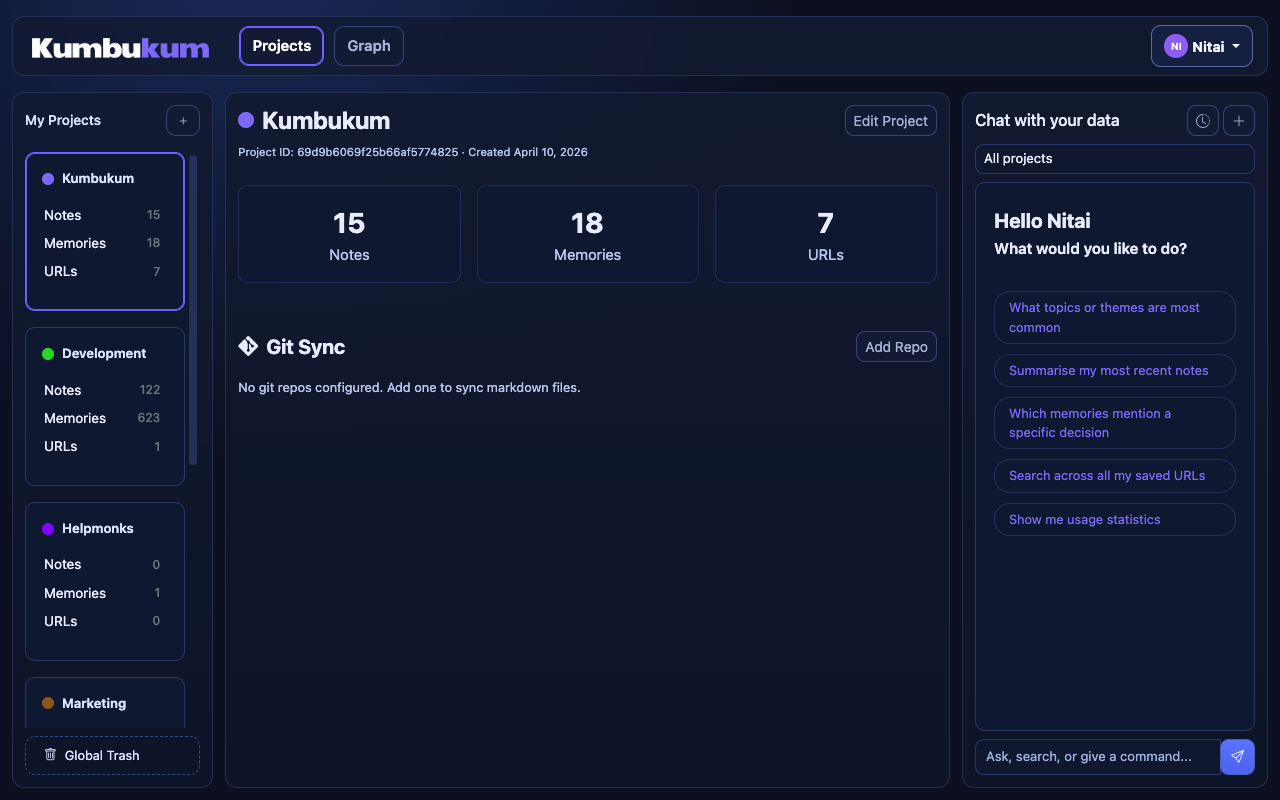
Kumbukum is built around the insight that context engineering should not require manual work. The persistent memory layer handles the curation, surfacing, and delivery of context so you can focus on the actual work.
When you connect Kumbukum to your AI tools via MCP, the relevant context loads automatically at the start of each session. The project state, decisions, preferences, and constraints are already in place. You do not maintain a markdown file or paste anything. The engineering happens in the background.
This also solves the cross-tool problem. Most people use more than one AI tool. Claude for writing, Cursor for coding, ChatGPT for research. Without a shared memory layer, each tool starts from zero. With Kumbukum, the context is the same regardless of which tool you open. The memory is not locked inside any one platform.
That is what makes context engineering scalable. Not better prompts, but a persistent layer that ensures every session starts informed.
Why This Matters More as AI Gets Better
There is a counterintuitive dynamic at work here. As AI models get more capable, context becomes more important, not less.
A smarter model with no context will give you a better generic answer. But a smarter model with rich, accurate context will give you an answer that is actually right for your specific situation. The ceiling on usefulness is set by what the model knows about you and your work, not just by its capabilities.
The teams and individuals who figure out context engineering now will have a compounding advantage. Their AI tools will get more useful over time as the context layer deepens, while everyone else keeps starting from zero and getting generic results.
Context engineering is the real AI skill of 2026. And the tools that make it automatic are the ones worth paying attention to.
One more thing that matters: Kumbukum is open source. You can inspect the code, self-host it, or contribute to the GitHub repository.
See how Kumbukum handles it at kumbukum.com.