
Your AI Remembers Your Name. It Still Doesnt Know Your Business.

Your AI knows your name. It might even remember you prefer bullet points over numbered lists, that you hate passive voice, and that you are building something in TypeScript. Pretty impressive, right?
But ask it about the decision you made last month to drop feature X because of a conflict with your API contract. It has no idea. Ask it why you picked vendor Y over vendor Z after three weeks of evaluation. Blank slate. Tell it you already tried the approach it just suggested - it confidently suggests it again.
That is not a memory problem. That is a depth-of-memory problem. And it is the gap between where AI assistants are today and where they need to be for builders, teams, and anyone doing real knowledge work.
The Two Types of AI Memory
When people talk about AI memory, they usually mean one of two things.
The first is preference memory - facts, settings, communication style. Your name. Your timezone. Your preferred stack. This is what tools like ChatGPT Memory, Claude Projects, and Cursor Rules handle reasonably well. It is shallow but useful. It means you do not have to re-introduce yourself every session.
The second is context memory - decisions, rationale, failed experiments, open threads, project state. Why you chose the current architecture. What you tried before that broke. What is blocked pending a third-party response. This is deep context. And almost no AI tool handles it.
The problem is most builders conflate these two. They get excited when their AI tool "remembers" them. Then they hit a wall three months in when it has no clue about the project they have been working on every day.
The Gap Is Bigger Than You Think
Here is a concrete example. You are six weeks into building an integration. You have made a dozen architectural decisions. You have tested three different approaches for the sync layer, abandoned two, and landed on a specific pattern with a known edge case you are tracking.
Your AI assistant can tell you your preferred code style. It can remember you like concise comments. It cannot tell you why the first two sync approaches failed. It does not know about the edge case you flagged. It has zero awareness of the decisions that define where your project is right now.
Every new session, you are starting from scratch on the things that matter most. The preferences are saved. The knowledge is gone.
This is not a complaint about AI limitations. It is a precise diagnosis of what type of memory is missing.
Why Native AI Memory Is Not Enough
All the major AI tools have shipped some version of persistent memory in the past year. ChatGPT Memory, Claude Projects, Cursor Rules - they all try to solve the re-introduction problem. They do it reasonably well for preferences. But they fail at project context for a few structural reasons.
They are tool-siloed. Your Claude memory does not follow you into Cursor. Your Cursor rules do not sync back to ChatGPT. If you use more than one tool - and most builders do - you are maintaining multiple disconnected memory stores. Each one has a partial picture.
They are shallow. ChatGPT Memory stores facts, not reasoning chains. Claude Projects can hold documents, but it is a static dump, not a dynamic memory that updates as your project evolves. There is no record of decisions, of failed paths, of live project state.
They are locked. Your memory is inside their walled garden. If you switch tools (and tools change fast), you start over. Memory portability is essentially zero with proprietary in-tool systems.
A real memory layer needs to be deeper, cross-tool, and yours to control.
What Business Context Actually Looks Like
Here is what genuine persistent memory for knowledge work should capture:
- Decisions made and the reasoning behind them
- Approaches tested and why they were abandoned
- Open threads and unresolved questions
- Project constraints that affect future work
- References and sources that shaped current direction
- Patterns that proved reliable or problematic
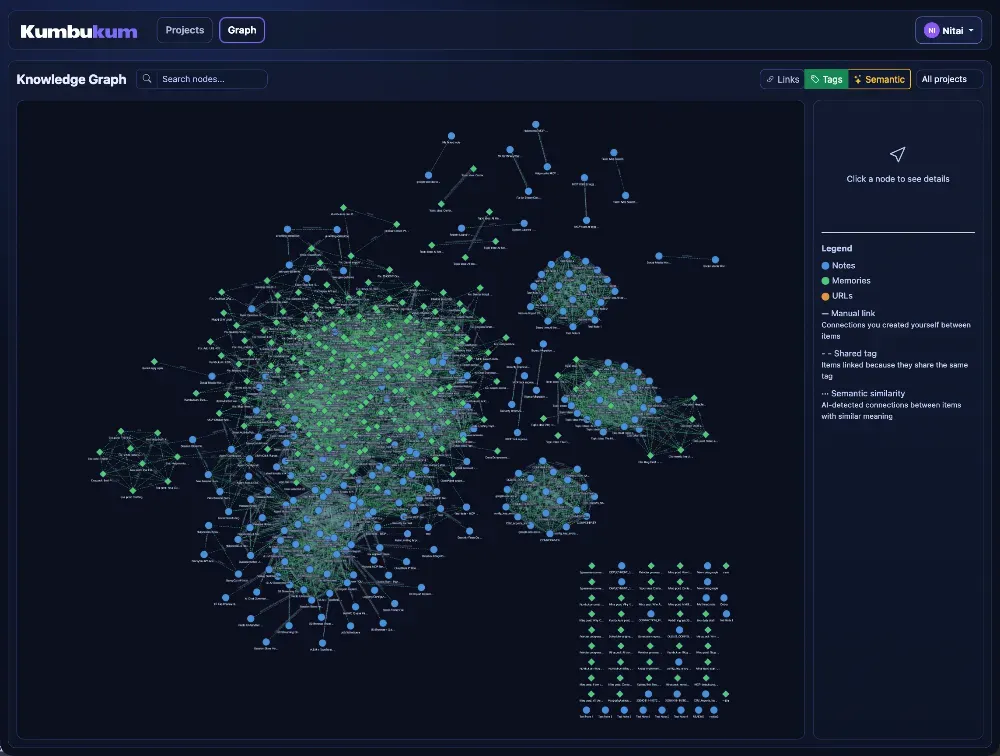
This is not a preference list. This is a living project record - the kind of thing that would let a new team member (or a fresh AI session) get up to speed on a project in minutes instead of re-discovering everything from first principles.
When you build with Kumbukum, this is what you are building toward. Not just remembering your name, but remembering your project.
Open Memory Infrastructure for Builders
The shift happening now in the builder community is toward open, transparent memory infrastructure. Tools like Kumbukum plug in via the Model Context Protocol - which means they work across Claude, Cursor, and any MCP-compatible tool. Your memory is not owned by one vendor. It is a layer you control.
That matters for a few reasons. First, portability - switch tools without losing context. Second, transparency - you can see exactly what your AI knows, edit it, extend it. Third, ownership - your data lives where you put it, not in some proprietary store you cannot inspect or export.
This is the builder-first principle: open infrastructure that you understand and control, not a black box you hope is working. You can read more about how Kumbukum's MCP integration works if you want to see the specifics.
The Practical Difference
Let me be concrete about what changes when AI memory goes deep.
Session one: You explain your project architecture. Kumbukum captures it.
Session two: Your AI already knows the architecture. You jump straight to the problem.
Session ten: You are working through a tricky edge case. Your AI recalls that you hit a similar issue with the sync layer in week three and abandoned approach B for a specific reason. It uses that context to give you a sharper suggestion.
Compare that to the current reality: session ten looks like session one. You are explaining the same constraints, the same history, the same context. You have repeated yourself ten times and your AI is no smarter about your specific situation than it was on day one.
That is the cost of shallow memory. It is invisible until you start measuring it.
Getting From Here to There
The good news is you do not have to wait for the big AI labs to solve this. The open-source MCP ecosystem is moving fast. Memory servers, knowledge stores, context persistence - these are being built by the same builder community that is frustrated by the limitations of native AI memory.
Kumbukum is one piece of that stack. It is designed to be the persistent memory layer that survives tool-switching, session resets, and the constant churn of AI tooling. It is open, auditable, and built for people doing real work - not just casual users who need their name remembered.
If you are a builder spending real time with AI tools, the right question is not "does my AI remember my name?" It is "does my AI know my project?" Right now, for most people, the answer is no.
That is the gap worth fixing. Try Kumbukum and see what AI memory looks like when it goes deep.
One more thing that matters: Kumbukum is open source. You can inspect the code, self-host it, or contribute at the GitHub repository.